
Michael Myers is dead. Laurie has stabbed him in the neck.
Michael Myers appears behind Laurie telling the kids she killed him.
Relatedly, Geelong got killed in the Grand Final last year. For most clubs, especially in the recent past, that kind of Grand Final result is a death knell for the next season. Then they got killed by Gold Coast in Opening Round, another thing that wouldn’t typically help a season.
For most clubs, that would be dying two deaths. But Geelong is 4-1 over their last five and just demolished the Bulldogs, who went into the game as a premiership contender.
In the process of destroying the Dogs, they got Jezza Cameron and Shaun Mannagh back in form and Patty Dangerfield back in the team and they franked themselves yet again as premiership contenders.
You can’t kill the boogeyman.
But this Geelong team is different to last year’s Geelong team, that was different to the previous year’s Geelong team that was different to the Geelong team that was still a contender 15 years ago.
They’re like if Michael Myers started with a knife, then learned jiu jitsu, then started running marathons and chased people until they had heart attacks, and now has a gun.
While this year’s Geelong team is still defined by the parade of anaerobic freaks they have running around, the Cats are trying to keep their finger off the turbo button so they can have it handy when they need it.
Where last year, the Cats basically had offensive and defensive specialists with guys like Ollie Dempsey and Bailey Smith only running offensively and Oisin Mullin, Mark O’Connor, and Tom Atkins only running defensively, the Cats are trying to deploy their entire team defensively this year.
Geelong baited Bulldog kicks into the corridor, which they are addicted to biting off, and chopped them off consistently. Bailey Smith and Max Holmes combined for 14 intercept possessions, almost all in the front half.
For the whole game the Dogs, who are a generally elite ball use team, had their second worst ball use game and their worst transition game of the year.
But the Cats only have that weapon available to them because of other edits that they’ve made to their game particularly when they have the ball.
Last year, Geelong’s ball use was pure rock and roll. They’d win the ball and spread at pace, aggressively attacking what they perceived to be open space like they were a colonial army. They were, as a result, eighth in time of possession at 41% and took about 99 marks a game.
The Cats are still like that to an extent, and still have the runners available to do it particularly as they’ve added other good athletes like Ollie Wiltshire and Tanner Bruhn, but still they’ve slightly adapted to the more Brisbane way of doing things. Ignoring the Gold Coast game in Opening Round that they essentially threw, the Cats are now fifth in time of possession at about 44% and are taking 102 marks a game.
With that extra time in possession and more time to set up behind the ball, the Cats have also cranked up their time in forward half from 53% last year to 56% this year which is leading the league and that’s before Tyson Stengle has played a game.
Both of those small changes now allow Geelong’s runners time to recuperate before launching another assault in transition, which they are still absolutely lethal in, taking the ball from defensive half to the forward 50 about 38% of the time, up from 34% last year.
And it’s those transition situations that I want to look at from Friday night.
The defensive revelation this year, such as it is from the Bulldogs, is that they had been able to flood players back into defence and essentially force teams to kick to contests so their pretty average defensive personnel is never in 1v1 situations.
Geelong’s athletes beat the flood like they were Noah.
Whenever Geelong got the ball back in defence, they always had players ahead of the ball to target, invariably feeding the ball into the space ahead of that player who was a better athlete than his direct opponent.
As they went down the field, the Cats generally tried to get the ball into Jack Martin or Shaun Mannagh’s hands to go inside 50. Once the kicker got it, their three stay at home forwards dispersed across the 50 creating a parade of 1 on 1 situations where the Cats had defined talent advantages. In the end Mannagh and Martin had a combined 18 score involvements.
Generally that left Cameron one out with some Bob Simms like Tom O’Donnell or Buku Khamis, but other than him it was Dangerfield or even occasionally Shannon Neale. We saw it most clearly in Cameron’s fourth goal, but really it was all night long.
Space is currency in modern footy. When Geelong has it, they know how to spend it. They have athletes all over the park that can win if you kick to space, and stars who can win if you give them space to work in.
The ability to spend it meant Rory Lobb, standing next to an en fuego Jeremy Cameron, fully understood how Jamie Lee Curtis felt when she was getting chased by Michael in every film.
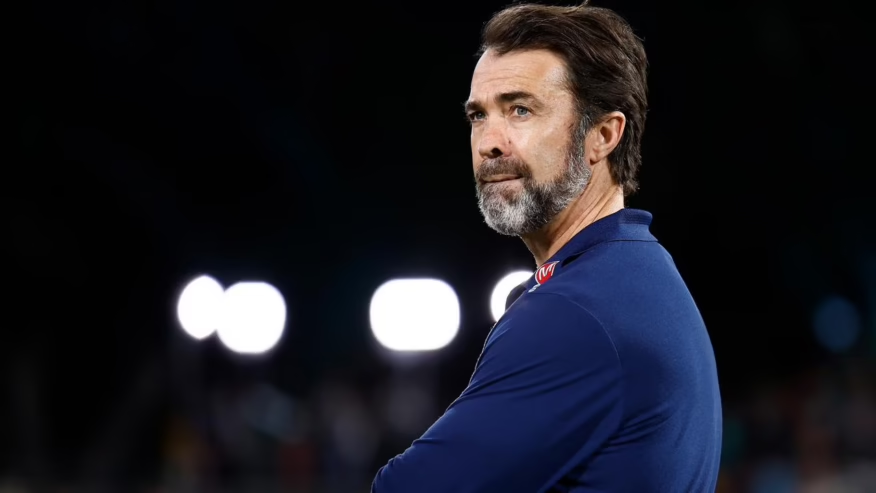
Where some teams would crumble after getting killed by Brisbane in last year’s Grand Final, not these Cats. Because the Chris Scott Cats can’t be killed.
You can’t kill the boogeyman.