
You know when you’re playing golf and you’re slicing them, so then you overcorrect and you start pulling them, then you correct the correction and on and on it goes until eventually the game drives you to a Tiger Woods style nervous breakdown without the sex.
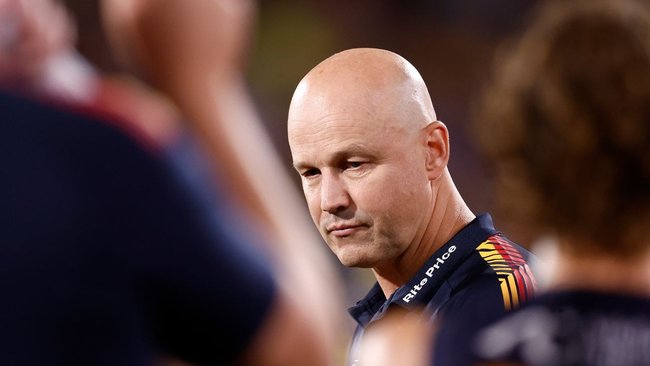
That’s been the Matthew Nicks story with the Crows over the last five years.
He has lurched from extreme defence to extreme attack year after year and this year, after finally reaching a nice equilibrium last year, he has lurched back into an overly defensive team that had its first 100+ point game against Carlton on Thursday night almost by accident.
But let’s go backwards to set the scene.
After taking over a dire footy club in 2020 and rebuilding it over his first three years, the Crows in 2023 were absolute rock and roll. They led the competition in scoring on the back of 76 Tex Walker goals, and 20+ from Izak Rankine, Darcy Fogarty, Luke Pedlar (remember him), Josh Rachele, and Ben Keays.
In that team, there were signs of what Nicks wants to do. They were a heavy and long kicking team, sitting fourth in kick percentage and third in metres gained per kick and bottom three in handball metres, but they were extremely dangerous at ground level and second in the league in contested ball. Generally, their method was to win the ball back in their defensive half and leave D50 long and to contest. They moved the ball either marking their long exits or winning on the ground.
But, despite a percentage of 116, which was fourth best in the competition, the Crows missed the finals winning just 10 games including their loss to Sydney when a clear Ben Keays goal wasn’t ruled a goal. They just didn’t defend well enough to be a genuine contender.
They were the 2025 Bulldogs before the 2025 Bulldogs.
That offseason, Nicks made his Crows a very defensive side.
They went from first to 12th in scoring in 2024 while not particularly improving their defensive numbers. But structurally, you could feel less willingness to attack of out stoppages particularly and a generally defensive mindset despite similar personnel.
They were like Walter White not wanting to ask for money from his rich mates, so he became a meth dealer and ending up getting himself killed prematurely anyway. It was taking a bazooka to the problem where a butter knife might have worked.
Last year, Nicks corrected again and finally got his porridge to the perfect temperature.
The Crows throttled down on their attacking game more with the emergence of Riley Thilthorpe, but also defended better built on the back of Mark Keane and Josh Worrell. For the first time in the Nicks tenure, they were top six in both scoring and defending scores.
They also became a mediocre front half side which was a big improvement from the previous couple of years, spending over half of their games in the front half for just the second time in Nicks’ tenure (2023 was the other).
They finished top of the ladder.
They were still a high kicking team, but they started to shorten their disposal especially out of the back half, falling to seventh in metres per kick and taking about 89 marks per game, which was just above league average.
However, they were bundled out in the finals in straight sets. In both of those games, the Crows gave up 15+ front half shots, two of their three worst games in that stat from the season.
Well, this year, Nicks has tried to correct again.
He has the Crows kicking long and wide out of defence again, generally to Jordan Dawson or Riley Thilthorpe. Once again, the Crows are at 28 metres per kick, three more than last year, and are bottom in expected threat per kick, second bottom in retention rating and 11th in ball use equity.
It’s a very Fremantle method for a team that doesn’t have Fremantle’s parade of star contested ball mids that allows them to kick long to contests constantly because they are so good in contested ball situations that they can force transition out of congestion. Adelaide trying that while pinning their third midfielder hopes to Jake Soligo, who has badly regressed, rather than Murphy Reid isn’t working as well as it does for Freo.
Because of their negative method, the Crows can’t move the ball. Part of that is that they’re feeling the loss of Mark Keane. Last year Keane and Worrell were defensive footy’s Pippen and Jordan. Both got to contest after contest and were able to provide both defensive grit while leading the Crow defenders in rebound 50s which added a level of bounce to Adelaide’s game that they don’t currently have.
Now, with Keane missing, Worrell and Wayne Milera are basically the only ones doing the rebounding, with James Borlase playing the Keane like defensive role without Keane’s athleticism or bounce.
They just lack teeth in moving the ball from the back half, and Keane missing is a key part of that. Last year, with Keane, they scored 39 points from the back half which was third in the league. This year, it’s 37.
The loss of Keane is also leaving more defensive midfield work for Jordan Dawson to do, meaning he can’t get as far up the ground and use his penetrating kicking to get closer to goal. Last year, Dawson averaged about 23 possessions per game and about 10 were in defensive midfield. This year, he’s at about 22 and 13 are in the defensive half.
In Matthew Nicks’ eternal quest to find the right approach, he’s stumbled upon it a couple of times but it doesn’t appear to be this year. Part of it is fixture, part of it is being forced to play whack-a-mole with personnel, but part of it is method.
Nicks needs to find a happy medium between the risk aversion he wants, and the risk he needs to take to start winning games against good teams, unless he wants this to be a wasted season for a list that needs to deliver soon if it’s going to deliver the ultimate glory at all.